Signed in as:
filler@godaddy.com

There is no community across Missouri’s 114 counties that have fewer than four special districts offering a public service of some kind to its residents, and rural communities tend to rely more heavily on districts, in some fashion, for essential services. Three-quarters of the state’s special districts provide essential services in counties with fewer than 50,000 residents.
Local county governance structures, presence of municipal services, and geographies tend to drive how special districts exist and operate across the state.
For instance: 150+ districts providing flood control predominately exist along the Mississippi and Missouri rivers, and around Southeast Missouri. Suburban Kansas City and St. Louis are both heavy with fire protection and, in some areas, public water supply districts as growing municipalities deferred the services over time, and allowing for reliable and community-controlled critical infrastructure services. All community public library services in the state are provided via special districts, and exist in all but two counties.

The majority of Missouri’s special districts glean their base revenues from local property taxes or have an option to levy local property taxes.
Some, including fire protection, ambulance, and certain library districts, may levy a limited local sales tax; and emergency 911 districts establish local sales taxes.
Despite the size and scale of the special purpose sector of local
government in Missouri, only 12 percent of the statewide “property
tax pie”, and 43 percent of the non-education property tax pie.
On the flip side - Missouri's public water supply and sewer districts primarily operate on rates, and the state's 114 soil and water conservation districts glean funds from the Missouri Parks, Soils, and Water Sales Tax.
Further, the majority of special districts may issue debt (bonds) to fund their infrastructure services (exceptions include developmental disability services boards [better known as "SB 40 Boards"], county health, and municipal library districts).
As local taxing entities, special districts are subject to the Hancock Amendments’ limitation on revenue growth.
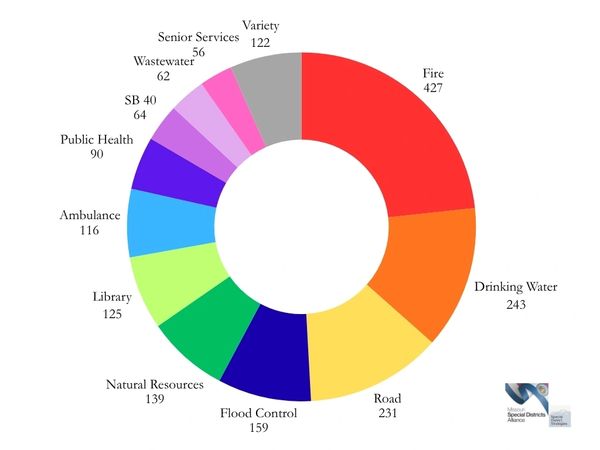
MoSDA has identified 1,837 special districts (2024, based on an analysis of reporting to counties, the State Auditor, and the State Tax Commission). Various state statutes outline each type of special district's governing structure: